


Ed Boal
Complexity has always been part of alternative funds work. What’s changed is the consequence of not fully understanding it.
A high-profile case, a familiar problem
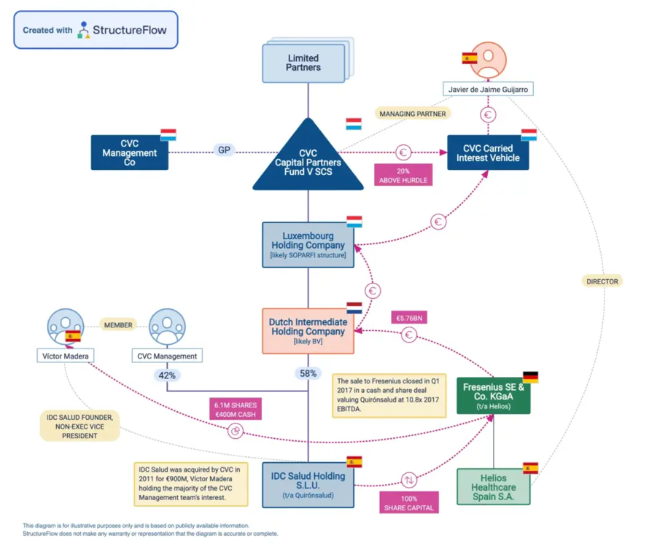
In 2025, a tax-fraud investigation involving CVC Capital Partners and Javier de Jaime, the firm’s top executive in Spain, drew attention across the private equity market. Public reporting tied the case to profits from CVC’s investment in Spanish hospital operator Quirónsalud, with scrutiny focused on the tax treatment of carried interest and the use of overseas holding structures.
Whatever the legal outcome, the case is instructive for a different reason. The structures themselves were not unusual for private equity—multi-jurisdictional, carefully engineered, and designed to balance tax, governance, and investor requirements. But like many modern fund structures, they were difficult to interpret in a clear and consistent way across stakeholders.
That is where risk begins to surface.
The growing gap between fund design and understanding
For funds lawyers, the takeaway isn’t whether these structures are permissible or well-designed. It is that when complex arrangements cannot be easily understood—by regulators, investors, or even internal teams—they become harder to defend under scrutiny. In today’s environment, that gap between design and understanding is increasingly where exposure lies.
A market that no longer tolerates opacity
Across private funds, the environment has changed in ways that are hard to ignore. Investors are asking more probing questions about control, economics, and downside scenarios. Regulators are paying closer attention to how structures are disclosed and justified. Internally, deal teams, tax advisors, and compliance functions are expected to move faster, but also with greater alignment. At the same time, structures themselves are becoming more complex, spanning jurisdictions, vehicles, and layers of governance that don’t always translate cleanly from paper to practice.
The result is a kind of structural opacity that doesn’t show up immediately. It surfaces later, often under pressure, when tax (and other) risks surface.
Where fund structures start to break
In practice, this is where deals begin to strain. A structure that made sense at formation becomes harder to explain during a continuation fund. Assumptions that seemed aligned across legal and tax teams start to diverge when tested in execution. Investor questions expose areas that are technically correct but not intuitively clear. None of this necessarily means the structure is wrong. But it does make the structure vulnerable.
The root of the issue is not complexity itself. Funds have always required complex structuring. The issue is that the tools and workflows used to manage that complexity have not kept pace. Legal work in this space is still overwhelmingly document-driven. Structures are described across offering documents, side letters, memos, and internal notes. Understanding depends on assembling those pieces into a coherent mental model—often under time pressure, and without a single, shared view.
That approach is starting to break down. Language is precise, but it is not always effective at conveying relationships. Ownership chains, control rights, and capital flows are inherently structural concepts. When they are expressed only in text, they become harder to interpret, harder to align on, and harder to test. When relationships live in dense documentation, critical knowledge is easily obscured and gaps are more likely to go unnoticed until later in the process.
The lesson from CVC: clarity, not just correctness
That dynamic is one of the clearest lessons from the CVC case. The issue wasn’t simply what the structure was. It was how clearly it could be understood across the parties who needed to rely on it.
Fund models that can be interrogated from the outset
What we’re seeing now is a shift in how leading funds lawyers, including tax teams, are responding. There is a move away from treating structure as something that is documented and then explained, toward treating it as something that is modeled and interrogated from the outset. This is where structural intelligence is beginning to play a more central role—not as a presentation tool, but as a way of working.
Making structures visible changes outcomes
When structures are modeled visually, the relationships between entities, rights, and flows become explicit. Misalignments are easier to spot. Assumptions can be tested earlier. Conversations with clients and investors become more grounded, because everyone is working from the same representation of how the structure operates. That shift has practical consequences. Teams report earlier identification of structural risks and fewer late-stage surprises when complexity is made visible early rather than reconstructed later.
For funds lawyers, this is less about efficiency and more about control. The ability to clearly articulate and defend a structure—to a client, to an investor, or to a regulator—is becoming just as important as the ability to design it.
New standards for fund structures
That’s the real takeaway from the CVC case. Complexity isn’t the problem. Unseen complexity is. And in today’s market, unseen complexity is harder to justify.
The firms that will stand out are not necessarily those designing the most sophisticated structures, but those that can make those structures transparent, aligned, and resilient under scrutiny. The standard is shifting, and it’s no longer enough for a structure to work in theory.
It has to be understood in practice—by everyone who depends on it.
Real-world impact
If there's one thing you need to know, it's everything.

Sam Whitman
Director of Knowledge Management
Holland & Knight LLP
StructureFlow significantly reduces the amount of time taken to create diagrams, making it easy for our lawyers to pivot and adapt a structure based on our clients' needs.

Walter Clark
Partner
Pinsent Masons
StructureFlow stands out because it is genuinely fixing a real problem making it so much easier for our lawyers to generate top quality group structure charts, which our clients love as well.

Nick Grandage
Global Head of Banking & Finance
Norton Rose Fulbright
The biggest benefit from StructureFlow is how it has improved our discussions with clients. It makes us a better law firm.

Nick Pryor
Director of Knowledge & innovation
Freeths
We use StructureFlow as a communication tool, a collaboration tool, with the third parties we work with - clients, accountants, private equity. There is so much room to grow and put StructureFlow in the centre of that.

Greg Baker
Global Head of Practice Innovation
Linklaters LLP
StructureFlow is now an integral part of our text workbench, enhancing the client and lawyer experience and driving efficiency.
