


Ed Boal
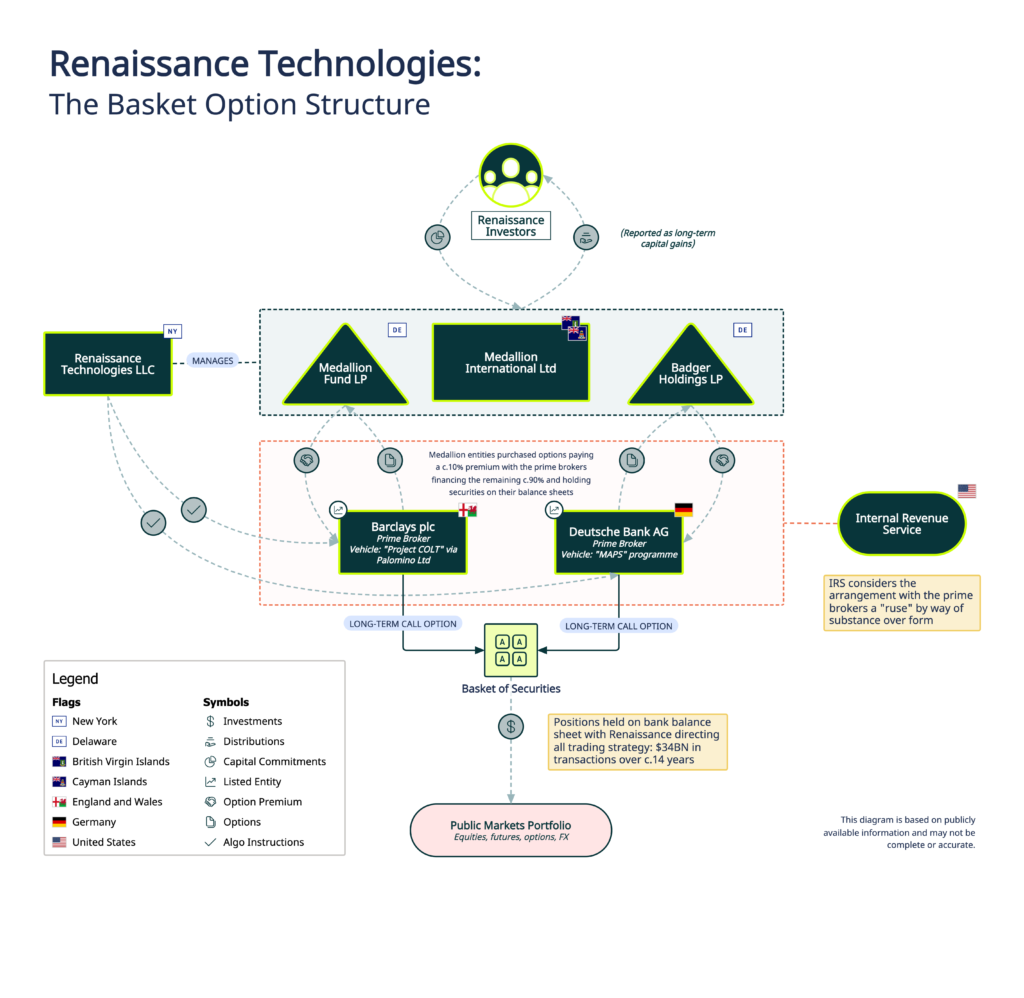
In 2021, quantitative hedge fund Renaissance Technologies paid $7 billion to settle a long-running tax avoidance dispute with the Internal Revenue Service. The settlement was big news, and not just for the remarkable dollar amount. Renaissance is famously successful and notoriously secretive, so any glimpse into the fund’s structure is of broad market interest. (We’ve created one in StructureFlow below.)
While Renaissance’s core issues was the substance of its structure and arrangements, the case demonstrates a broader truth: that regulatory scrutiny of complex transactions and tax structures inevitably extends to how those arrangements were documented and explained. With heighted enforcement across tax and financial regulation, the imperative to document, explain, and ultimately defend structural decisions is increasingly acute. When tax authorities arrive with questions, firms producing documentation that is not just comprehensive but also readily comprehensible will be substantially better positioned.
When tax arbitrage goes wrong
The average holding period of a position in Renaissance’s flagship Medallion Fund is reported to be two days. The fund’s short-term trading approach has been remarkably successful, producing an estimated annualized return of around 40%, net of fees. But there is one notable downside: gains on such trades are taxed as ordinary income.
Seeking more favorable tax treatment, Renaissance turned to a derivative-based alternative known as “basket options.” The fund’s prime brokers—Deutsche Bank and Barclays—held its positions on their own balance sheets, granting Renaissance a long-term call option on the portfolio. Renaissance continued to direct the trading, but because the option was held for more than a year, profits from short-term trading inside the basket could be treated as long‑term capital gains when the option was exercised. Medallion Fund investors thereby avoided the higher ordinary income tax rate. A 2014 U.S. Senate report estimated the tax avoidance benefit at $6.8 billion over roughly a decade.
Formal IRS guidance issued in 2015 on the heels of the Senate report marked the end of the basket options strategy. Renaissance fought the case through the IRS appeals process, but after several years of wrangling the firm opted to settle.
Rising regulatory expectations
Tax professionals globally are facing heightened compliance challenges. Tougher regulatory action is the product of two fundamental drivers. One is the desire to raise revenue by taking a more aggressive stance against structures that prioritize form over substance. The Renaissance case is a prime example.
The second key driver is an international push for greater tax transparency. The OECD’s BEPS framework, the EU’s DAC6 mandatory disclosure rules, and the IRS’s increasing reliance on economic substance doctrine have collectively raised the bar for what constitutes adequate documentation of a tax-driven structure. Funds operating across borders now face overlapping disclosure obligations from multiple jurisdictions, each with its own expectations about the level of contemporaneous evidence required to support a structural tax position.
In an environment of closer regulatory attention, firms must be more prepared than ever to “show their work” in response to regulatory inquiries. Across transfer pricing, fund formations, cross-border reorganizations, and holding-company design, substance-over-form scrutiny has intensified. Firms must demonstrate how and why a particular structure was designed—what alternatives were considered, which assumptions informed the tax position, and how decisions evolved over time. Disputes increasingly turn on evidencing contemporaneous documentation and on the transparency of the decision-making trail.
The documentation challenge
Meeting these heightened expectations is challenging in part because traditional documentation practices have been suboptimal. Relevant documents and data often are not aggregated in one logical place. The big picture is held together primarily through the tribal knowledge of a small group of key individuals.
The limitations of that approach are increasingly evident as structures and transactions become ever-more complex. Even the most experienced and diligent professionals can struggle to navigate a web of disconnected documents, models, and diagrams. The problem compounds when key personnel leave or new team members must be brought up to speed on an existing structure’s history and rationale. Quite apart from regulator demands, the traditional documentation practices create significant operational risk and inefficiency in today’s world.
A role for modern visualization tools
Traditional responses to the documentation challeng – structured memos, knowledge management systems, dedicated tax workpapers – address parts of the problem, but tend to produce static snapshots that quickly become outdated. Interactive modelling tools offer a different approach. By capturing each decision, iteration, and dependency as the work evolves, they can create a living, auditable narrative that tracks the rationale behind a structure from inception through execution. When done well, this provides the kind of contemporaneous evidence trail that tax authorities increasingly expect.
Interested in how we can help you get clarity on your tax structures or fund entities?
Book a call. No obligation. Just a chat.
Real-world impact
If there's one thing you need to know, it's everything.

Sam Whitman
Director of Knowledge Management
Holland & Knight LLP
StructureFlow significantly reduces the amount of time taken to create diagrams, making it easy for our lawyers to pivot and adapt a structure based on our clients' needs.

Walter Clark
Partner
Pinsent Masons
StructureFlow stands out because it is genuinely fixing a real problem making it so much easier for our lawyers to generate top quality group structure charts, which our clients love as well.

Nick Grandage
Global Head of Banking & Finance
Norton Rose Fulbright
The biggest benefit from StructureFlow is how it has improved our discussions with clients. It makes us a better law firm.

Nick Pryor
Director of Knowledge & innovation
Freeths
We use StructureFlow as a communication tool, a collaboration tool, with the third parties we work with - clients, accountants, private equity. There is so much room to grow and put StructureFlow in the centre of that.

Greg Baker
Global Head of Practice Innovation
Linklaters LLP
StructureFlow is now an integral part of our text workbench, enhancing the client and lawyer experience and driving efficiency.
