


Ed Boal
In recent weeks, a tax-fraud investigation involving CVC Capital Partners has dominated headlines in Spain, and by extension, the broader private equity world.
The investigation centres on whether the carried interest returns made by CVC Capital’s managing partner, Spanish national Javier de Jaime Guijarro, in connection with the sale of Spanish hospital operator Quirónsalud to Germany’s Fresenius Helios, should have been taxed as employment income (up to 45-50%+ progressive rate) rather than capital gains (approx. 20-28%). The Spanish authorities claim that the Luxembourg/Dutch structure was one of ‘substance over form’, avoiding the payment of over €350M in taxes.
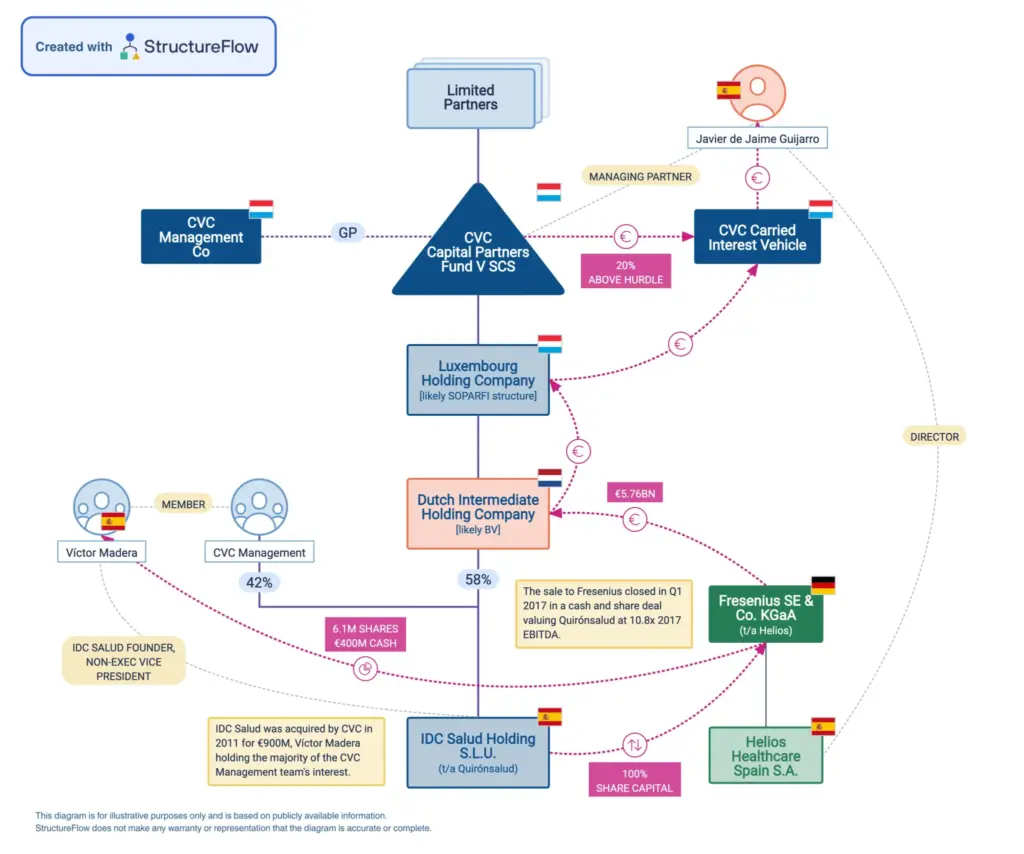
While the investigation is still unfolding, one thing is already clear: this isn’t just about one firm or one case. It’s about the growing scrutiny on how financial structures are built, managed, and understood.
At its heart, this story is a reminder of a truth that the legal and financial professions have quietly known for years: complex deal structures are also risk structures.
The price of invisible complexity
For decades, the private equity industry has operated on a foundation of ingenuity, structuring deals with surgical precision to optimise for returns, tax, and flexibility. Those structures are often masterpieces of design: multi-layered entities spanning jurisdictions, intricate flows of capital, and contractual relationships that balance risk and reward.
But as those structures have become more complex, so too has the task of managing them. Today, even the most diligent professionals can find themselves buried under layers of documents, models, and diagrams, each one a partial truth, disconnected from the rest.
And when your understanding of a structure depends on navigating static documents and spreadsheets, you don’t just slow down the work. You lose visibility. And when you lose visibility, you lose control.
That’s when complexity turns costly.
The new reality: visibility is non-negotiable
The CVC case underscores a broader market shift: regulators, investors, and clients all want transparency.They’re asking tougher questions about ownership, governance, and flow of funds. They expect faster, clearer answers, and they assume those answers are grounded in data.
This represents a strategic shift in what it means to be trustworthy.
The firms that can surface, explain, and defend their structures, visually and confidently, will win the confidence of clients and regulators alike. Those that can’t will find themselves explaining complexity that no one wants to hear.
In the past, lawyers, advisors, and deal teams relied on static diagrams and descriptive text. But in today’s environment, words alone don’t convey clarity. A written summary can’t reveal misalignments or hidden dependencies. Only a living, data-connected model can do that – one that allows professionals to see the structure, spot the risks, and understand the implications instantly.
From documentation to intelligence
We’re witnessing a quiet but profound transformation in how complex transactions are designed, communicated, and governed. Firms are moving beyond documentation toward data-driven visual intelligence, interactive models that connect entities, contracts, and flows in real time.
This isn’t about making prettier charts. It’s about upgrading cognition, helping professionals think more clearly, act more confidently, and communicate more effectively with clients and stakeholders.
When you can see the structure, and interrogate the data underlying it, you can surface the risk. When you can surface the risk, you can manage it. And when you can manage it, you can build trust. The ultimate differentiator in a world where every deal is under the microscope.
The competitive advantage of clarity
Complexity is inevitable in law and finance. Opacity is not.
The firms that thrive in this next era of transactional work will be those that treat clarity as a competitive advantage, adopting technologies and workflows that make structures visible, data connected, and decisions defensible.
Whether you’re managing a fund, advising a client, or executing a cross-border transaction, the question is no longer “Do we understand our structure?”
It’s “Can we prove we do clearly, instantly, and visually?”
Because when the next investigation hits the headlines, visibility won’t just protect reputations. It will define them.
Real-world impact
If there's one thing you need to know, it's everything.

Sam Whitman
Director of Knowledge Management
Holland & Knight LLP
StructureFlow significantly reduces the amount of time taken to create diagrams, making it easy for our lawyers to pivot and adapt a structure based on our clients' needs.

Walter Clark
Partner
Pinsent Masons
StructureFlow stands out because it is genuinely fixing a real problem making it so much easier for our lawyers to generate top quality group structure charts, which our clients love as well.

Nick Grandage
Global Head of Banking & Finance
Norton Rose Fulbright
The biggest benefit from StructureFlow is how it has improved our discussions with clients. It makes us a better law firm.

Nick Pryor
Director of Knowledge & innovation
Freeths
We use StructureFlow as a communication tool, a collaboration tool, with the third parties we work with - clients, accountants, private equity. There is so much room to grow and put StructureFlow in the centre of that.

Greg Baker
Global Head of Practice Innovation
Linklaters LLP
StructureFlow is now an integral part of our text workbench, enhancing the client and lawyer experience and driving efficiency.
