


Ed Boal
On 18 May 2026, a jury in Oakland, California, took less than two hours to throw out the most expensive AI lawsuit in history. Three weeks of trial. The world’s first trillionaire on the stand for three days. $150 billion in alleged damages. And the jury came back before lunch on what Elon Musk’s own lawyers described as a “calendar technicality.”
The question the jury had to answer wasn’t about artificial intelligence, or about whether Sam Altman had, to use Musk’s own words, “stolen a charity.” It was a structural question: when did OpenAI’s entity structure change in a way that should’ve told Musk he had a cause of action – and did he wait too long to sue?
The question that had to be answered wasn’t unique to Elon Musk. It sits inside every restructuring, every acquisition, every fund structure, and every governance review. And the reason the jury answered it so quickly is that once you could see the structure, the answer was obvious. This article walks through that structure, phase by phase, and explains why visibility matters.
Phase 1: OpenAI’s formative years (2015 – 2017)
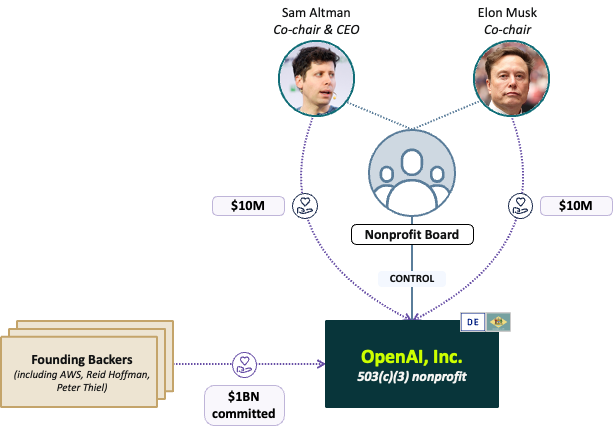
OpenAI, Inc. was incorporated in Delaware on 8 December 2015 as a 501(c)(3) nonprofit corporation. The Certificate of Incorporation enshrined a single, unambiguous charitable purpose: to fund research, development and distribution of artificial general intelligence for the benefit of humanity, unconstrained by any need to generate financial return. Sam Altman and Elon Musk were named as co-chairs; the founding board comprised just two members.
By the time of OpenAI’s public announcement, the founding backers – among them Reid Hoffman, Peter Thiel, Amazon Web Services, and Infosys – had pledged approximately $1 billion in donations directly to this single entity. Musk began contributing his own money to OpenAI, Inc. in 2016, eventually donating approximately $44 million across a four-year period.
The governance structure at this stage was as simple as it looks: one entity, with a nonprofit board controlling everything. The mission and the governance were the same thing. There was no investor return mechanism, no commercial arm, and no mediation of control through any intermediate entity. The nonprofit board could hire or fire the executive team, set strategic direction, and dispose of assets – all without reference to any outside stakeholder.
The Form 990 filings for 2016 confirm that the board subsequently increased to four board members, with Elon Musk and Sam Altman among them. By late 2017, Greg Brockman and Ilya Sutskever had joined the board, alongside Holden Karnofsky of Open Philanthropy, which had by then contributed $30 million of its own money.
Phase 2a: The capped-profit hybrid (March 2019)
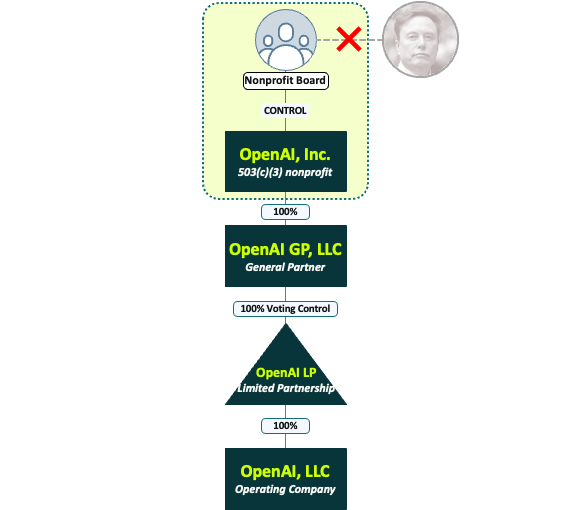
Musk left the OpenAI board in February 2018. The public explanation was a potential conflict of interest with Tesla’s AI development. The evidence that emerged at trial suggested that the real reason was a dispute about control: Musk had proposed taking a majority stake in a planned for-profit subsidiary, or alternatively folding OpenAI into Tesla, and the co-founders had rejected both. He continued donating to OpenAI, Inc. after his departure.
In March 2019 – publicly announced via blog post authored by Altman and Brockman – OpenAI created a layered structure beneath the nonprofit to allow external investment. The mechanism was a limited partnership: OpenAI LP, a “capped-profit” entity that would cap investor returns at 100x their investment, with any excess flowing back to the nonprofit. The control chain, as confirmed by OpenAI’s 2020 Form 990 filings, ran as follows: OpenAI, Inc. (the nonprofit) wholly owned OpenAI GP, LLC, which served as general partner of OpenAI LP, which in turn controlled OpenAI LLC as the operating entity.
The blog post was explicit about what this meant: “going forward, ‘OpenAI’ refers to OpenAI LP, which now employs most of our staff, and the original entity is referred to as ‘OpenAI Nonprofit.'” The capped-profit structure was framed as a principled compromise – a way to raise the capital necessary to compete at the frontier of AI development, while retaining nonprofit oversight through the GP structure.
The mediation of governance is worth pausing on. The nonprofit no longer directly managed the commercial operation. Its authority now ran through OpenAI GP, LLC – a wholly owned subsidiary acting as general partner of the LP. That is a real but indirect form of control: the general partner has management authority over the LP under the partnership agreement, but the nonprofit exercises that authority at one remove rather than directly. Whether that distinction mattered depended entirely on how the partnership agreement was drafted, and specifically on what approval rights, if any, the limited partners held.
Musk, for his part, testified at trial that he didn’t regard this change as a breach. “If you’ve got a capped-profit situation,” he said, “it hasn’t violated the nonprofit’s goal. There was no basis for me to file a lawsuit at that time.”
Phase 2b: Microsoft’s investment (July 2019)
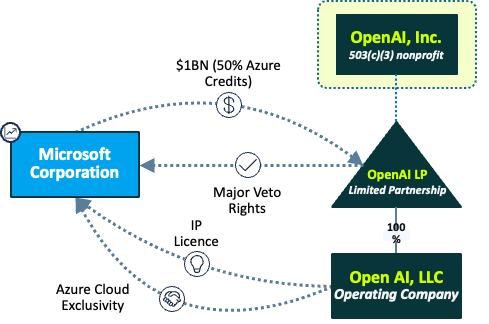
Four months after the LP was formed, Microsoft announced a $1 billion investment in OpenAI LP. Approximately half of that figure took the form of Azure compute credits rather than cash. In return, Microsoft received exclusive Azure cloud computing rights – OpenAI agreed to use Azure as its sole cloud provider across all workloads – together with a commercial technology licence allowing Microsoft to commercialise OpenAI’s intellectual property and sell access to it through its own products which included Microsoft Copilot and Github Copilot.
What the press release didn’t disclose, but what internal documents later surfaced in the litigation confirmed, is that Microsoft’s position in the LP gave it structural leverage well beyond the size of its headline investment. As the dominant limited partner, holding approximately 85% of total LP contributions at that point, Microsoft held majority approval rights over ‘Major Decisions’ under the partnership agreement – including changes to the company’s structure, distributions, and any merger or dissolution.
The UK Competition and Markets Authority, reviewing the Microsoft-OpenAI relationship in the context of AI market investigations, concluded that Microsoft had acquired “material influence” over OpenAI through this deal – stopping short of finding de facto control, but going considerably further than the public announcement had suggested.
This is the arrangement that Musk testified he found acceptable. The CMA’s characterisation of it as conferring material influence is, on reflection, the more instructive one.
Phase 3: Entity proliferation (2020-2024)
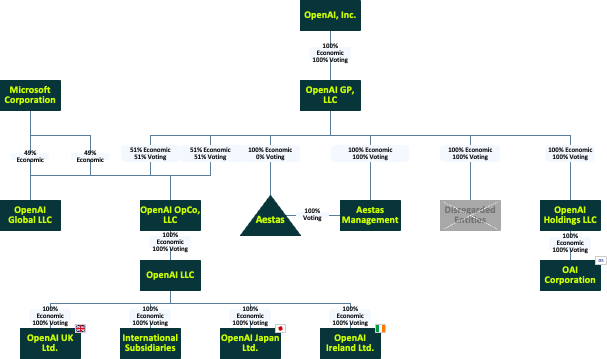
Over the following four years, the picture changed rapidly. Microsoft invested a further $13 billion across multiple rounds: approximately $2 billion in March 2021 (accompanied by a second amendment to the Joint Development and Commercialisation Agreement extending Microsoft’s IP commercialisation rights), and a $10 billion commitment announced in January 2023 at a $29 billion valuation. The 2023 deal gave Microsoft IP rights, a profit share, and veto rights over major OpenAI corporate decisions – a formalisation of the structural position it had already informally occupied since 2019.
Within OpenAI’s entity structure, one entity became fifteen. The 2020 Form 990 showed six entities; by 2024, the public filings disclosed: OpenAI GP LLC, OpenAI OpCo LLC (the renamed LP, converted from a limited partnership to an LLC in January 2023), OpenAI Global LLC, OpenAI Holdings LLC, Aestas LP, Aestas Management Company LLC (formerly OpenAI Holdings LP), OAI Corporation (formerly OAI Corporation LLC, converted to a corporation in September 2023), OpenAI Global HoldCo Inc., OpenAI LLC, and seven international subsidiaries in Ireland, the United Kingdom, Japan, and elsewhere.
The governance changes across this period were equally significant. Reid Hoffman and Shivon Zilis departed the board in March 2023. Will Hurd resigned in July 2023 to pursue a presidential campaign. Holden Karnofsky had already left following his wife’s co-founding of Anthropic. By November 2023 the board was a six-person body: Brockman as chairman, Altman as CEO, Ilya Sutskever, Adam D’Angelo, Tasha McCauley, and Helen Toner – technically independent but with no commercial investor representation, and limited corporate governance experience.
That board, on 17 November 2023, fired Altman as CEO for “lack of candour.” Brockman resigned from the board the same day in protest. Microsoft’s CEO Satya Nadella was personally involved in the subsequent negotiations. Over 700 of OpenAI’s approximately 770 employees signed an open letter threatening to resign unless the board was overhauled and Altman reinstated.
Within five days, Altman was back. The board was replaced entirely, save for D’Angelo. Bret Taylor – former Salesforce co-CEO and Twitter’s final board chair – took over as chair. The reconstituted board was considerably more commercially oriented than the one it replaced.
Musk described the cumulative effect of this period in his federal complaint as an “opaque web of for-profit OpenAI affiliates, engaged in rampant self-dealing.” The self-dealing allegation is disputed, but the opacity allegation is more interesting. None of what happened during this period was secret: every new entity appears in OpenAI’s Form 990 filings, every board change was either publicly announced or derivable from the filings, and every Microsoft investment was publicly disclosed. The information existed. What didn’t exist was a model that made the relationships between those fifteen entities legible – that showed you which entity held the IP, which held the employees, which held the commercial relationship with Microsoft, and how far the nonprofit’s governance authority actually ran through the structure.
That is a visibility problem. And it is the visibility problem that made the statute of limitations question so hard to answer from documents alone.
Phase 4: Completion of the recapitalisation (October 2025)
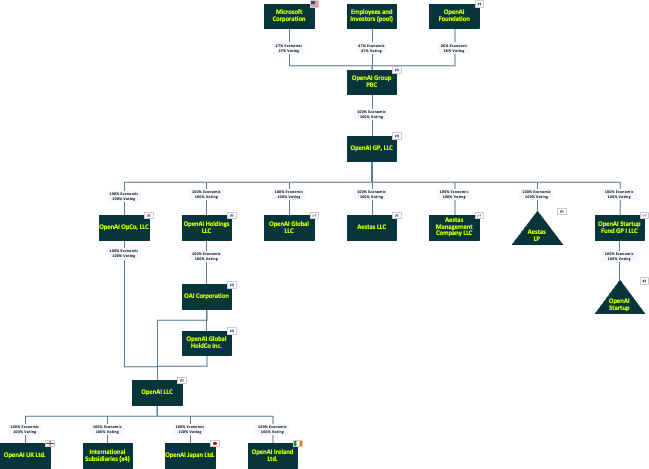
On 28 October 2025, OpenAI completed its recapitalisation. The capped-profit LP structure – the 2019 hybrid that had been straining under fifteen entities and a $13 billion Microsoft relationship – was replaced with a single Public Benefit Corporation: OpenAI Group PBC, incorporated in Delaware.
The nonprofit was renamed the OpenAI Foundation and held 26% equity in OpenAI Group PBC – worth approximately $130 billion at the October 2025 valuation – and retained 100% of board appointment rights. The PBC was legally obligated to uphold the Foundation’s charitable mission. Microsoft held approximately 27%, valued at $135 billion. Employees and investors held the remaining 47%. The profit cap – the 100x return limit that had been the defining feature of the structure since 2019 – was removed entirely.
The California and Delaware Attorneys General reviewed the plan before it closed, following nearly a year of negotiation and concessions. The California AG’s conditions included specific obligations on AI safety oversight and risk mitigation for younger users. Musk had tried to block the restructuring by applying for a preliminary injunction – which the court declined – and separately by making a $97.4 billion bid to acquire the nonprofit, which OpenAI rejected. His comment at the time: “They stole a charity and used it for their own financial gain.”
The structural change that is easy to miss in the headline terms is this: per court documents filed in the litigation, OpenAI GP LLC is now a subsidiary of OpenAI Group PBC – not of the Foundation. The Foundation no longer sits above OpenAI GP in the ownership chain. Its control of the commercial operation is exercised through board appointment rights and contractual obligations, not through direct ownership. In 2015, the nonprofit owned everything; in 2019, it governed through a general partner sitting above a capped-profit LP’; and in 2025, it held board appointment rights and a 26% minority equity stake in a company it no longer sat above in the ownership chain.
The control mechanism had changed from ownership, to governance, to rights.
The competing timelines: when did Musk know?
Musk v. Altman was filed as a case about breach of charitable trust. It was decided as a case about when Musk discovered the alleged breach. The statute of limitations for fraud under California law is three years from the date of discovery; for unjust enrichment, two years.
Musk’s position was that he had no reason to file until November 2022, when he learned of Microsoft’s planned $10 billion investment and texted Altman: “What the hell is going on? This is a bait and switch.” He described this as Phase 3 of his view of OpenAI – the moment when he concluded “the for-profit is the tail wagging the dog.” His team argued that a pattern of reassurances from Altman – delivered after each structural development – had reasonably tolled the clock. Each time Musk raised concern, he was told the nonprofit remained in control.
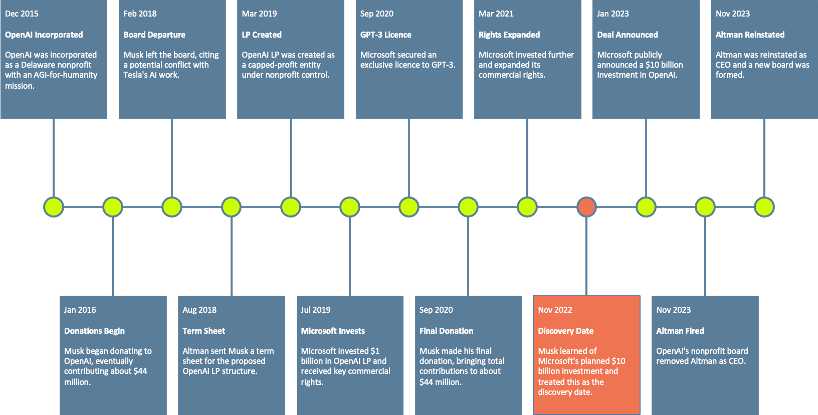
OpenAI’s position was that Musk had constructive knowledge of the structural change considerably earlier. They identified four alternative discovery dates:
- In 2017, Musk himself admitted under oath that he had suspected he was being “swindled” during internal discussions about the for-profit subsidiary.
- In August 2018, Altman had sent Musk a term sheet for OpenAI LP – which, OpenAI argued, constituted constructive knowledge regardless of whether Musk read it carefully.
- In March 2019, the LP formation was publicly announced via blog post.
- And in July 2019, Microsoft’s $1 billion investment was announced via joint press release.
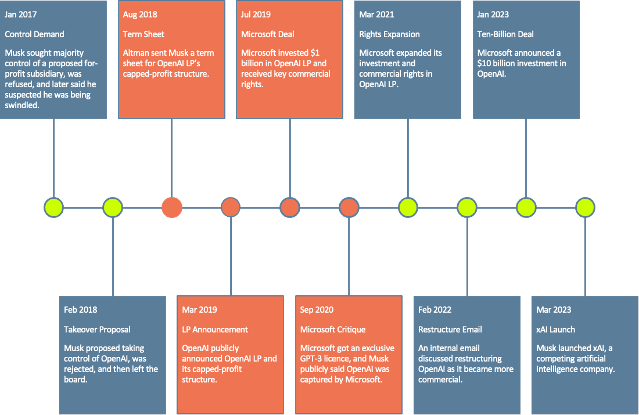
On any of these dates, OpenAI argued, the three-year and two-year limitation periods had already run before Musk filed in August 2024.
Yet OpenAI’s strongest exhibit was not a filing or a contract, it was a tweet:
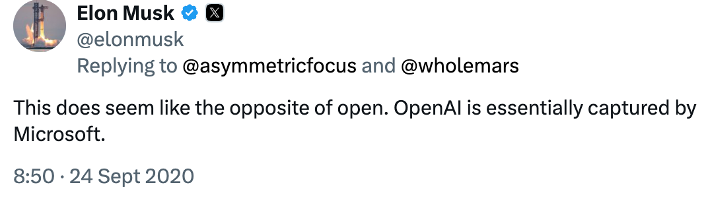
That is Musk’s own contemporaneous, public expression of the precise concern that formed the basis of his claim – four years before he filed. On the two-year unjust enrichment limitation period, that tweet alone required him to file by September 2022. He filed in August 2024.
The jury came back in under two hours.
The structural visibility argument
Both arguments in Musk v. Altman were structural arguments. Musk’s case rested on showing that the structure still looked like a nonprofit in control at each stage, and that Altman’s reassurances gave him no reason to look harder. OpenAI’s case rested on showing that the structural change was visible and public from 2019 at the latest – and that Musk’s own public statements demonstrated he had seen it.
Neither argument could be properly evaluated without laying the entity structure and the timeline side by side. The limitation question – “when should someone have known?” – only becomes answerable when you can map what was visible in the structure at each point and compare it against what each party claimed to know.
Few clients are likely to be engaged in litigation of this scale or profile. But the underlying question – when did the structure change, who should have known, and what does the governance chain actually look like right now? – is live in every matter where structure is involved. Whether you are advising on a fund recapitalisation, a cross-border acquisition, a tax restructuring, or a governance review, there are questions that only have answers in the structure itself – not in any single document, and not in any AI-generated summary of documents.
The problem is never the information. In Musk v. OpenAI, every entity addition, every board change, and every investment round was in the public record. The problem is that this information lived in documents, and documents that described the structure. They don’t show it.
The answer was always in the structure. The question is whether you could see it.
Real-world impact
If there's one thing you need to know, it's everything.

Sam Whitman
Director of Knowledge Management
Holland & Knight LLP
StructureFlow significantly reduces the amount of time taken to create diagrams, making it easy for our lawyers to pivot and adapt a structure based on our clients' needs.

Walter Clark
Partner
Pinsent Masons
StructureFlow stands out because it is genuinely fixing a real problem making it so much easier for our lawyers to generate top quality group structure charts, which our clients love as well.

Nick Grandage
Global Head of Banking & Finance
Norton Rose Fulbright
The biggest benefit from StructureFlow is how it has improved our discussions with clients. It makes us a better law firm.

Nick Pryor
Director of Knowledge & innovation
Freeths
We use StructureFlow as a communication tool, a collaboration tool, with the third parties we work with - clients, accountants, private equity. There is so much room to grow and put StructureFlow in the centre of that.
Greg Baker
Global Head of Practice Innovation
Linklaters LLP
StructureFlow is now an integral part of our text workbench, enhancing the client and lawyer experience and driving efficiency.
