


Kari Hughes
Why law firms serving hedge funds need to think like Structural Intelligence partners, not just document processors
A recent With Intelligence piece made a sharp observation about the hedge fund industry: capital is consolidating into billion-dollar platforms, but scale alone doesn’t produce alpha.
With Intelligence’s Billion Dollar Club (BDC) report found that hedge fund assets managed by BDC firms grew more than 19% year over year to $4.05 trillion by the end of 2025, yet the research is blunt about what that scale buys. On average, hedge fund alpha is statistically indistinguishable from zero. Among retail hedge funds specifically, only about 14.3% show statistically significant positive alpha — still far higher than the 0.03% figure for active retail mutual funds, but a reminder that real, repeatable skill is rare even in that pool.
The article’s real argument isn’t “big is good” or “boutique is good., it’s that structure has to fit strategy. Legal wrapper, governance, fee design, investor base, and capacity constraints aren’t administrative details bolted onto a good idea…they’re part of whether the idea works at all.
That argument matters just as much for the law firms advising these funds as it does for the funds themselves.
The parallel: your firm’s structure is part of your strategy too
Hedge fund managers are being asked a hard question by allocators: is your structure actually built for the edge you claim to have, or is it just inherited scale? Law firms serving this industry face a version of the same question from their clients.
A fund’s edge increasingly depends on speed. How fast it can stand up a new SPV, restructure around a regulatory change, or get an investment committee comfortable with a complex multi-entity trade before a competitor gets there first? When that speed depends on a partner manually redrawing an entity chart in PowerPoint, or an associate reconstructing a fund’s structure from a stack of PDFs before a call, the firm becomes a weaker link in the client’s own structural edge.
This is where StructureFlow fits directly into the story the hedge fund indsutry is telling.
Structural intelligence as the law firm’s version of “fit”
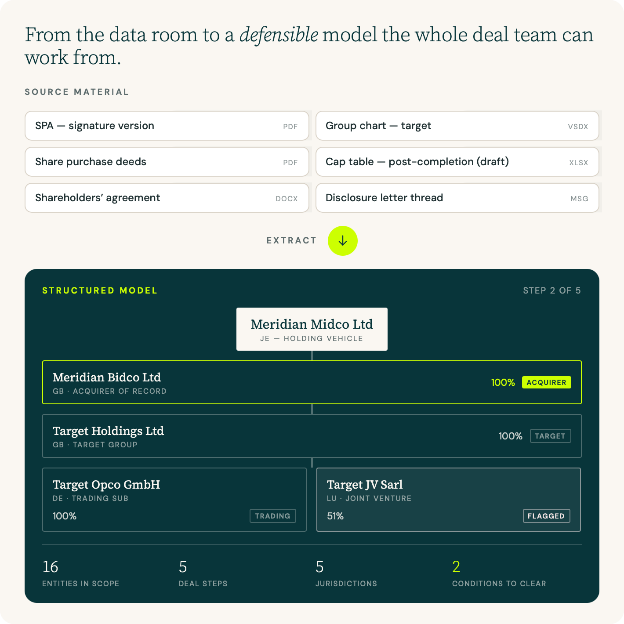
StructureFlow is built around a simple premise: the entity structures underneath a deal — feeders, blockers, parallel funds, SPVs, counterparties, jurisdictions, capital flows — shouldn’t live in static diagrams that go stale the moment they’re emailed. They should live in a connected, visual, always-current model.
Mapped against the themes from the above, the case for a firm adopting this becomes concrete:
1. Governance and oversight depend on structural clarity. The article cites research arguing that large platforms win partly through stronger governance and risk oversight. But governance is only as good as the structural picture underneath it. A law firm that can produce a live, accurate view of a client’s fund structure — rather than a document that was correct at signing but not since — is directly supporting the governance edge the client is trying to build.
2. Fees and terms are structural, and structural errors are expensive. The article details a discussion of performance-fee equalization — how high-water marks, crystallization periods, and share classes can produce different outcomes for investors in the same fund — and it’s a reminder that structural precision has direct financial consequences. That’s exactly the kind of downstream dependency StructureFlow is designed to surface before it becomes a problem at review, audit, or LP conversation.
3. Capacity-constrained strategies need faster structuring, not slower. The article notes that some of the best hedge fund opportunities are niche and capacity-aware — meaning speed and precision at smaller scale matter more, not less. A boutique fund moving into a specialized opportunity can’t afford to have its legal counsel be the bottleneck. StructureFlow’s live modeling — instead of a redrawn chart every time terms shift — keeps the firm from being that bottleneck.
4. Distribution and communication are part of the fund’s structural advantage. The article stresses that as hedge fund products reach more private wealth investors, clear communication about liquidity, risk, and structure becomes essential. Law firms are often the ones translating structural complexity into something an investment committee, an LP, or a regulator can actually understand quickly. A visual, connected model does that translation work faster and more convincingly than a static org chart.
The business case, stated plainly
The With Intelligence article’s closing question is whether each hedge fund’s structure is genuinely built for the edge it claims to deliver. Law firms serving this market should be asking the same question about their own operating model.
A firm that still treats structural mapping as a manual, back-office task is, in effect, choosing a structure that doesn’t fit the speed its hedge fund clients are competing on. A firm that adopts a platform like StructureFlow is doing the legal-services equivalent of what the article says the best-performing funds do: matching its own structure — its workflow, its speed, its ability to surface hidden dependencies — to the strategy it’s actually trying to execute, which is being the fastest, clearest, most reliable structural partner in the room.
In a market where alpha is scarce and structure is increasingly recognized as strategy, the firms that make that same shift internally aren’t just improving efficiency. They’re making themselves a structural advantage their hedge fund clients can point to.
Real-world impact
If there's one thing you need to know, it's everything.

Sam Whitman
Director of Knowledge Management
Holland & Knight LLP
StructureFlow significantly reduces the amount of time taken to create diagrams, making it easy for our lawyers to pivot and adapt a structure based on our clients' needs.

Walter Clark
Partner
Pinsent Masons
StructureFlow stands out because it is genuinely fixing a real problem making it so much easier for our lawyers to generate top quality group structure charts, which our clients love as well.

Nick Grandage
Global Head of Banking & Finance
Norton Rose Fulbright
The biggest benefit from StructureFlow is how it has improved our discussions with clients. It makes us a better law firm.

Nick Pryor
Director of Knowledge & Innovation
Freeths
We use StructureFlow as a communication tool, a collaboration tool, with the third parties we work with — clients, accountants, private equity. There is so much room to grow and put StructureFlow in the center of that.

Greg Baker
Global Head of Practice Innovation
Linklaters LLP
StructureFlow is now an integral part of our tech workbench, enhancing the client and lawyer experience and driving efficiency.
